Budget 2026 doesn’t move the dial on child poverty rates
FOR IMMEDIATE RELEASE
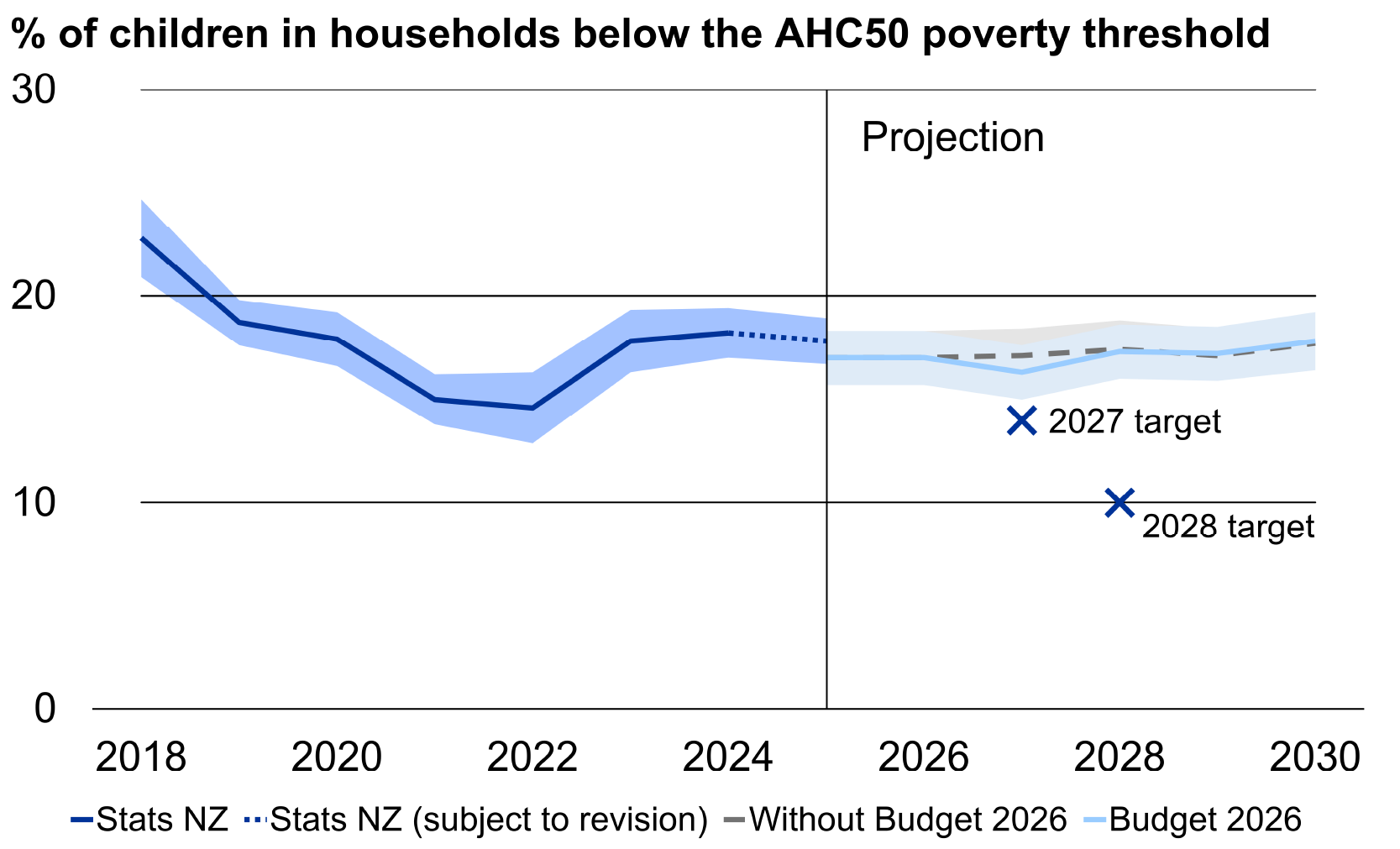
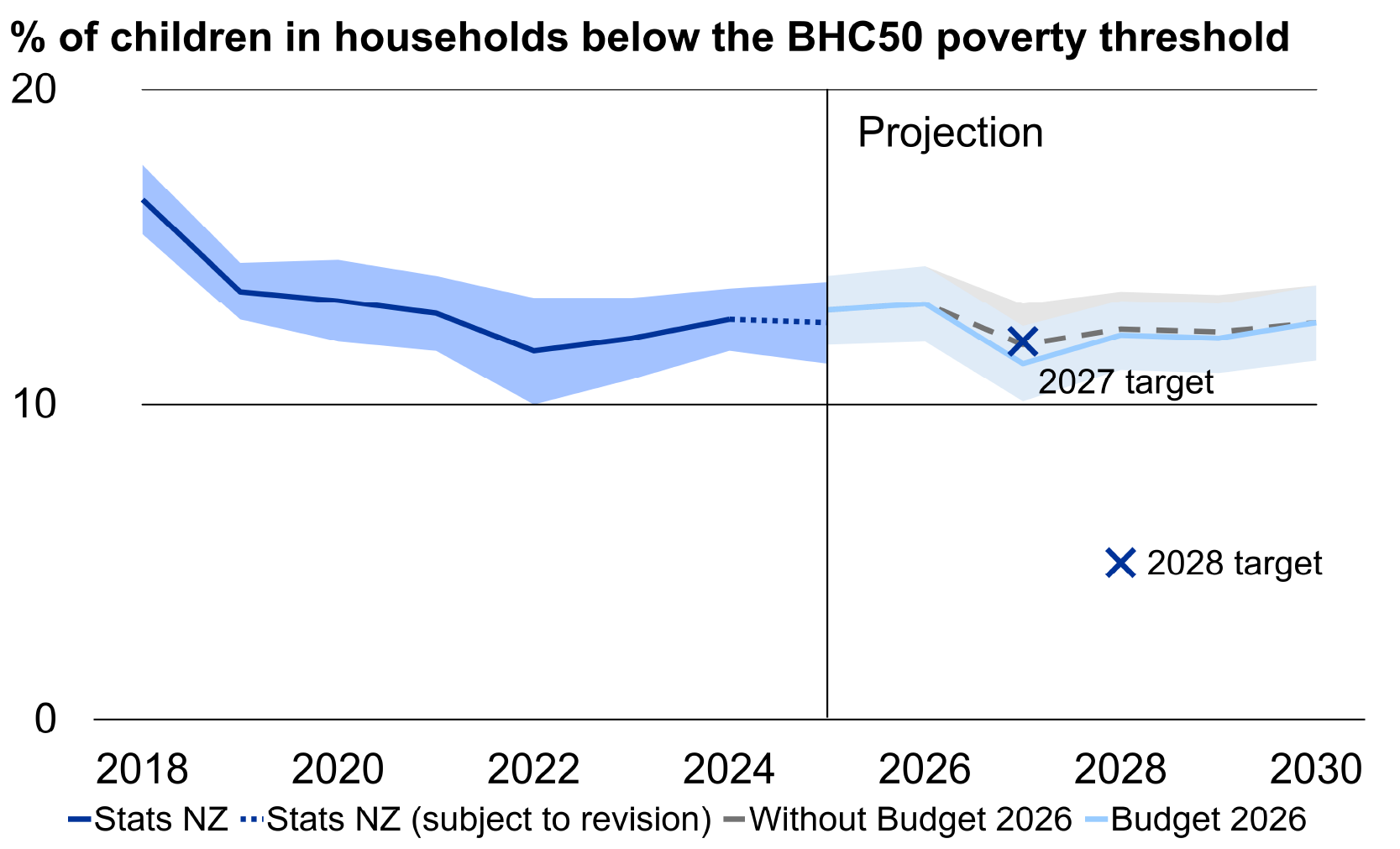
For yet another year, Treasury’s child poverty forecasting shows no movement toward hitting the 2028 goal of halving child poverty in accordance with the Child Poverty Reduction Act 2018.
Child Poverty Action Group (CPAG) says, taken as a whole, Budget 2026 doesn’t meaningfully shift the dial on child poverty.
Forecasts:
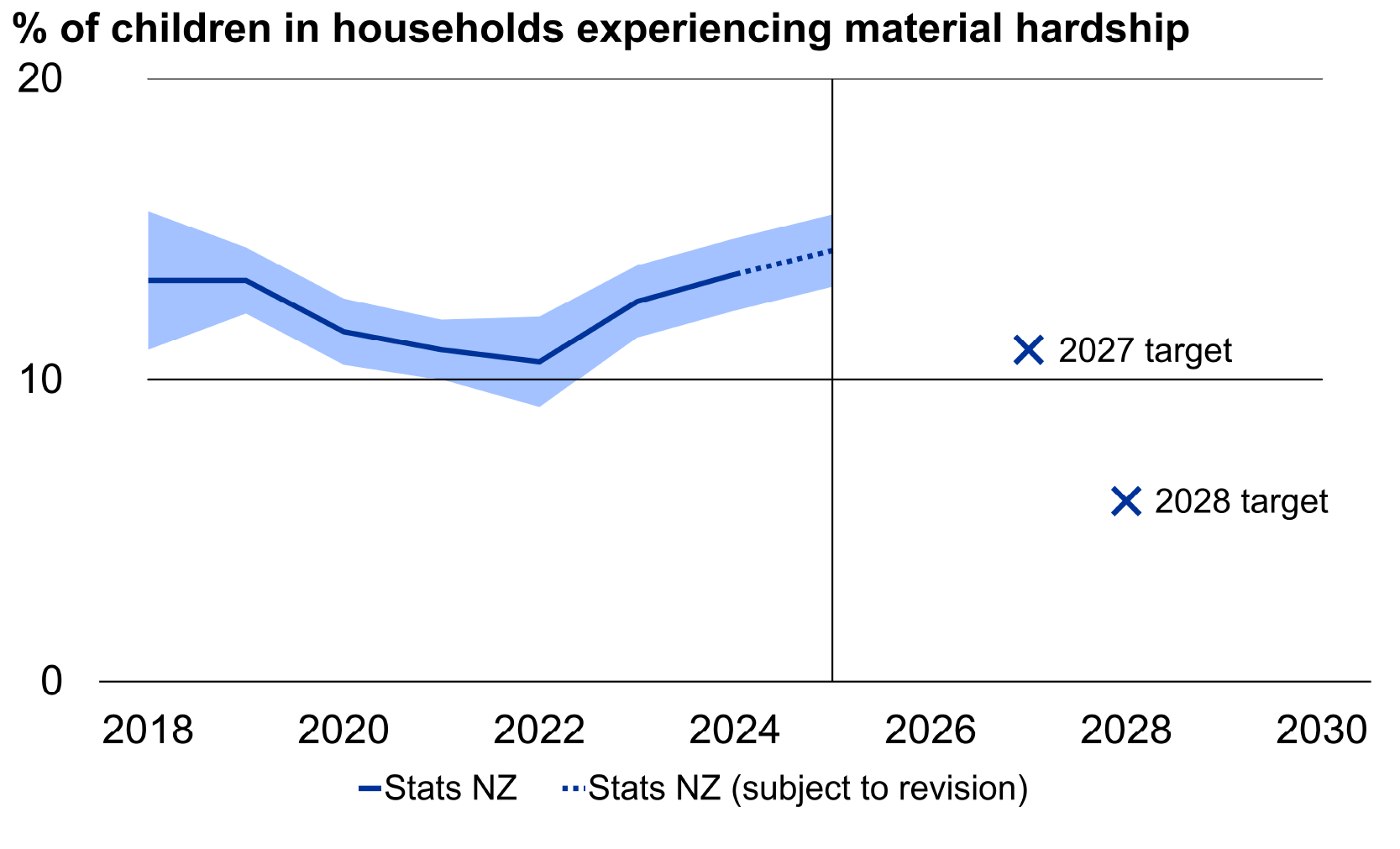
Of the three child poverty measures that Treasury models, only one is set to hit the 2027 target. The rest will miss, and all are miles away from the 2028 targets.
It is important to note that the 2027 targets were set by Child Poverty Reduction Minister Louise Upston in 2024 as part of the Government’s Child and Youth Strategy.
This was a target the Government set because it “wants to make the target achievable” (Figure 2), yet even after it’s lowered the bar, it’s still failing to clear it.
Initiatives:
Fuel support
The temporary $50 increase to the In-Work Tax Credit will provide welcome relief for many working families. However, CPAG remains deeply concerned that children in families receiving income support continue to be excluded from this assistance through the discriminatory design of the Working for Families system.
With unemployment forecast to rise to 5.5 percent in mid-2026, more families are likely to experience periods out of paid work due to broader economic conditions, not personal choice. In that context, maintaining a two-tier system of support for children becomes even more difficult to justify.
A child’s access to food, housing, and essentials should not depend on their parents’ employment status. If the Government recognises that rising living costs require additional support for children in working families, it is hard to imagine a world where it doesn’t also mean that support should also be extended to children in households receiving income support.
Housing
The Government’s flagship “housing support fairness” package effectively asks some of the lowest-income families in the country - those in public housing - to pay more of their income in rent in order to fund modest increases in support for private renters. While reducing inequities between housing support systems is a legitimate policy aspiration, it should not come at the expense of households already struggling to meet basic needs.
The increase in Income-Related Rent from 25 to 30 percent of income represents a direct reduction in disposable income for many low-income families in public housing. About 84,000 households will see rents increase by around $31 a week on average. For households already facing impossible choices between food, power, transport, and school costs, this matters.
At the same time, the Government is reducing access to Temporary Additional Support (TAS), one of the few mechanisms available to families facing acute hardship. Cutting the maximum TAS rate sends the wrong message during a cost-of-living crisis and risks deepening material deprivation for children.
General initiatives:
More broadly, the Budget continues a pattern of relying on foodbanks, food hubs, and charity-based responses as core pillars of social support. While community providers do extraordinary work, food insecurity is ultimately a systems issue in a country that feeds 40 million people globally a year. Children need incomes that are adequate and secure, not ongoing dependence on emergency food assistance.
Community resilience is not a long-term solution to child poverty, it is a temporary band-aid, and the longer the Government leaves the band-aid as the only solution, the less effective it will be.
The continuation of school lunch programmes and investment in social housing are positive steps, but they are mitigations of hardship, not solutions to poverty.
There are also serious concerns about the impact on the public services and community infrastructure children and whānau rely on. Behind every frontline service are the policy, administration and coordination roles that keep income support, housing assistance, public health and community services functioning effectively. Reducing state capacity can mean longer waits, weaker support systems, and greater barriers for families already under pressure.
Child poverty is the result of policy choices. Ending it requires a sustained commitment to income adequacy, affordable housing, and an unconditional approach to supporting children. Budget 2026 contains few short-term relief measures, but it falls well short of the transformational change needed to ensure every child in Aotearoa can thrive.
Media contact:
Isaac Gunson
comms@cpag.org.nz